
Reading Albany County Arrest Reports
Albany County has no single countywide booking log. Public information arrives in layers. Dated Albany Police material covers the city. VINE answers whether someone is in custody. Police-source blotters and a private rolling index round out the picture. Each layer answers a different question, and none forms a complete roster.
The official Albany County Sheriff News page posts selected releases, not every commitment to the county jail. APD puts daily arrest material on Facebook by policy. That social archive is not a stable weekly database. A sound multi-day search starts with official releases and ends with agency or court verification.
Trace an Albany County Arrest
Work with dated entries instead of merging search results into one log. That habit keeps the arrest, later custody, publication, and disposition on separate lines.
- Identify the municipality, likely agency, and arrest-date range.
- Check that agency's official news or social source first and preserve its post date.
- For Colonie, review the Spotlight News police blotter, noting its selective weekly form.
- Use the Times Union local section for sourced case reporting, not a complete roster.
- Check VINE only for the person's reported county custody state.
- Obtain the agency report or court disposition when the web window ends.
For events from today only, use the Albany County arrested-today guide. Its APD and booking-lag focus differs from this trail. The Times Union Capital Region page shows the local reporting a wider search draws on.
Stories may add police or court context, but publication is newsroom-driven and selective.
Fields in Albany Arrest Reports
A police release, a news digest, a custody result, and a copied booking entry are not the same record. Keep the source label beside each fact.
| Field | Meaning and limit |
|---|---|
| Name | The spelling used by that source, not conclusive identity by itself. |
| Arrest date | The police event; it may precede booking or publication. |
| Booking date and ID | Intake timing and a local key, when published. |
| Agency | The office making or reporting the arrest. |
| Charge or code | An charge recorded at that stage, not a disposition. |
| Custody or transfer | A status tied to event time, which may later change. |
| Photo | May be editorial, agency-supplied, or copied; no county public photo roster was located. |
Sources often skip bond, court dates, booking numbers, or photos. Never fill those gaps from an unrelated private page. An entry saying someone went to county jail before arraignment marks a step in the process, not current custody.
Weekend Arrest Reports and Delays
No official Albany source follows a fixed schedule. Weekend and Monday posting is not guaranteed. A pile of Monday articles does not prove a weekend booking surge. A quiet feed does not mean nobody was arrested. Paperwork, editorial choices, platform access, and review can all push publication past the event date.
One slow news story can disguise the real date of an Albany County arrest.
Spotlight's Colonie feature runs weekly or on a period. Times Union reports cases as news warrants. Sheriff releases appear event by event, and the private index's claim of multiple daily updates is the publisher's word, not an official cadence.
Police Blotters Fill a Narrow Gap
Spotlight News gives the clearest local example. Its Colonie weekly blotter draws on police reports. Entries may list charges, warrant pickups, transfers to another department, and pre-arraignment detention at Albany County jail. It adds narrative details a custody result may not show.
The value has limits. This blotter is an editorial selection, not ACCF's permanent daily commitment and discharge record. It can run days or weeks late. It cannot show whether someone remains in custody. Times Union covers individual Capital Region cases with police, prosecutor, or court sourcing, but with no fixed booking cadence.
Check any photograph's type first. A newsroom image is not a scene photo. File photos and agency-supplied images mean different things too. Do not label one an ACCF mugshot without source proof.
Archived Albany County Arrest Records
Old pages roll off, but the record often survives. New York Correction Law §500-f makes the county jail's daily commitment and discharge record permanent. The LGS-1 schedule also keeps the master summary permanent. It generally retains prisoner data and case records for 15 years after death or discharge. That holds unless the data replaces the permanent master.
File a focused request through the Albany County FOIL route. Give the full name and an approximate arrest or admission date. Add the agency and any booking or case number. Ask separately for an existing booking photograph. No photo retention series exists, so the records officer decides which rule applies.
For historical jail research, the Hall of Records keeps an 1825 to 1976 collection. It spans the old jail and penitentiary. Admission and discharge registers, surname indexes, and microfilm sit inside it. That archive is not a current arrest log. The county record guide ties current FOIL, sealing, and archival paths together.
Three Clocks Behind One Arrest
Albany's record trail runs on three clocks. Police policy and official releases describe enforcement. VINE reports custody and release events, while news and private pages summarize selected facts on their own calendars.
| Layer | Best use | Main limit |
|---|---|---|
| Agency release | Who arrested, when, and alleged charge | Selective, not a custody roster |
| VINE | Reported county custody and notifications | Can lag and is not a court record |
| News or private index | Multi-day discovery and context | Incomplete, unofficial, or editorial |
The rolling RecentlyBooked Albany page is an unofficial secondary source with a 30-day view and photos. Never label it the Sheriff roster. Verify names and charges with the agency or court. The unofficial Albany County rolling page displays that secondary layer in practice.
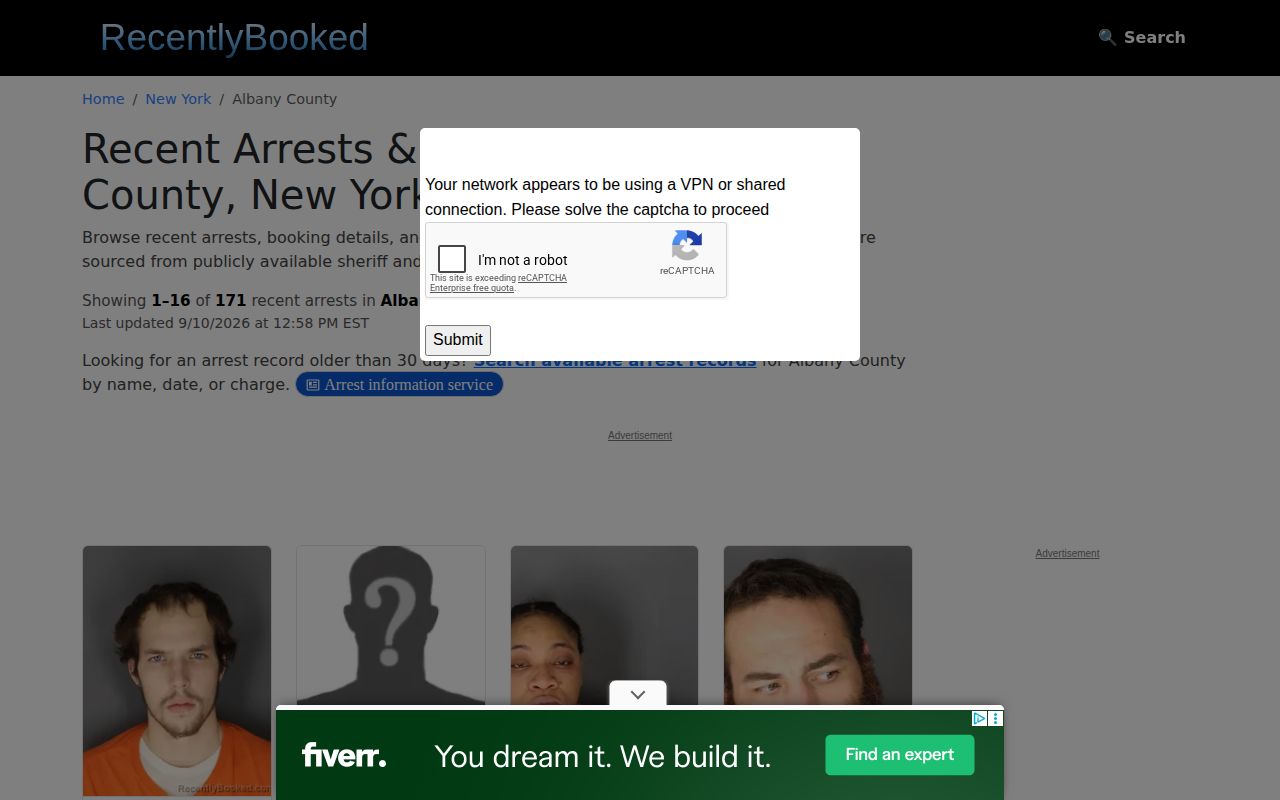
Read it as private context, not a Sheriff roster.
Arrest Reports Are Not Case Results
An Albany County blotter entry captures one moment in time. Where the case goes next depends on the courts. Lower-level matters move to arraignment in a local court, while felony proceedings unfold in Albany County Court. Charges may be amended there or dropped altogether.
Note: Arrest reports record events; only the courts decide how a case ends.
Want the court side of a matter? The official County Court page lays out felony jurisdiction. Local courts take the smaller stuff. If you learn a final disposition, report it with its source and date rather than quietly rewriting the original entry. OCA runs a statewide Criminal History Record Search too. You search by name and date of birth, and it costs $95. Sealed material stays out of it. It is a court-history tool, though, not an Albany County booking log, so it cannot tell you who is in custody right now.
Build a Reliable Arrest Timeline
A multi-day arrest review holds together best as a simple timeline. Split it into fields. Record the event date, the arrest date, the booking time, publication time, VINE update, and court date. Keep the agency and URL beside each entry. This keeps a late article from shifting when an arrest seems to have happened.
Choose neutral verbs that mirror the source. Police "reported" an arrest. A jail record "listed" a commitment. VINE "displayed" a custody status. A court "entered" a disposition. If a private index is the only place a fact appears, say so and look for official confirmation. Skip sensitive fields that add nothing to identifying the record.
Older matters carry their own limits. An archival admission record proves a jail entry and nothing more. It is not a modern booking photograph or a conviction. A current VINE no-result is just as narrow. Albany County's record layers only mean something while time, source, and custody state stay attached.
Corrections matter too. When an article is corrected, keep the correction date and use the updated version. When an official record is sealed or access tightens, never rebuild the missing facts from a private copy. The goal is an accurate timeline, not the longest list.